Unlike autonomous driving or industrial robotics, healthcare robotics can’t rely on internet-scale data collection or unlimited real-world experimentation. Every demonstration requires specialized equipment, clinical expertise, and access to patients or laboratory environments. This creates three fundamental challenges for developers.
Official announcementNVIDIA Developer Blog
Developing Healthcare Robotics with GPU-Native Medical Physics Simulation
שלא כמו נהיגה אוטונומית או רובוטיקה תעשייתית, רובוטיקה של שירותי בריאות לא יכולה להסתמך על איסוף נתונים בקנה מידה אינטרנט או ניסויים בלתי מוגבלים בעולם האמיתי.... בניגוד לנהיגה אוטונומית או רובוטיקה תעשייתית, רובוטיקה של שירותי בריאות לא יכולה להסתמך על איסוף נתונים בקנה מידה אינטרנט או אלא

First is the data gap. Training modern robotic policies requires demonstrations across diverse anatomies and procedures. Most teams have only hundreds of demonstrations—not the tens of thousands needed to build robust systems. But even if collecting millions of demonstrations were practical, the most important cases would still be missing. This is because healthcare is dominated by the long tail. Rare anatomies, challenging patient physiology, complications, and failure modes occur too infrequently to be adequately represented in real-world datasets. Yet, these are the cases that matter most for clinical safety.
This data gap leads directly to the second challenge: generalization. Imitation learning inevitably plateaus at the edges of the data distribution. Reinforcement learning (RL) offers a path beyond that plateau. RL can explore millions of interactions, stress-test policies, and learn from failures. To do so effectively, it needs simulation that is realistic enough to produce meaningful policies—and fast and scalable enough to train at scale.
The third challenge is development velocity. Medical robotics development relies on benchtop phantoms, cadaver studies, animal models, and limited clinical evaluations. These remain essential, but they are inherently sequential, expensive, and difficult to scale. Iterating on designs and algorithms currently takes months, pushing total development cycles to 4–7 years.
These three challenges point to the same missing infrastructure: an open, GPU-native simulation framework capable of modeling device–anatomy interactions with the fidelity required for robot training.
NVIDIA Medical Physics Simulation framework—an open source, GPU-accelerated capability within NVIDIA Isaac for Healthcare, was built to fill that gap. Developers can generate anatomical digital twins, simulate device–anatomy interactions and medical imaging, and train reinforcement learning policies at GPU scale—all within NVIDIA Isaac Sim and NVIDIA Isaac Lab.
A GPU-native simulation framework for healthcare robotics[](#a_gpu-native_simulation_framework_for_healthcare_robotics)
Medical Physics Simulation provides both classical physics-based solvers and generative world-model-based simulators for real-time simulation of device–anatomy interactions—enabling RL-ready policy training across healthcare robotics segments. Both modules provide a modular research and engineering platform for interactive surgical and interventional simulation, robot learning, synthetic data generation, and procedure development. They are well suited for machine learning workflows because both simulation and learning run on the same GPU, avoiding the overhead of repeated CPU–GPU memory transfers.
Classical solvers [](#classical_solvers )
The Endoluminal Simulation Module is released for general availability in Isaac for Healthcare. It enables real-time simulation of diagnostic and interventional procedures involving long, flexible surgical instruments navigating through endoluminal cavities. It is implemented as a standalone package, so it can be integrated independently into different workflows and environments. This initial release shows catheter navigation through the vascular system under fluoroscopic guidance.
The module is implemented in Python using NVIDIA Warp and Newton Physics. The flexible instruments are modelled as Cosserat rods, providing a solid theoretical foundation for simulating materials’ bending, twisting, and stretching deformation. To capture the complex nonlinear dynamics of these one-dimensional rods efficiently on the GPU, extended position-based dynamics (XPBD) was selected as the primary simulation method.
XPBD typically relies on local, iterative constraint projections. For long instruments, however, local projections may require many iterations to propagate motion from the controlled proximal end to the distal tip. This module instead assembles the coupled rod constraints into a matrix system.
Each rod segment contributes six constraint equations—three for stretch and shear and three for bending and twisting—producing a block-tridiagonal XPBD system with 6 × 6 blocks. The Thomas algorithm solves this system in linear time with respect to instrument length, while independent instruments are processed concurrently across vectorized environments on the GPU.
This globally coupled solver propagates inputs such as proximal insertion and rotation along the entire instrument within each simulation step, even for very long instruments, enabling immediate response to user manipulations at the distal end.
Figure 1. Catheter insertion and steering through a vascular model
Related stories

Official announcement
Giga-Scale AI and the Ethernet Evolution: How Spectrum-X Ethernet Rewrites the Rules
NVIDIA Developer Blog
The massive growth of generative AI has fundamentally altered data center design. As distributed model training scales to span hundreds of thousands of GPUs,... The massive growth of generative AI has fundamentally altered data center design. As distributed model training scales

Official announcement
How AI Coding Agents Can Unlock Materials Simulation with NVIDIA ALCHEMI Toolkit
NVIDIA Developer Blog
Atomistic simulation requires three things: knowledge of the science, compute-efficient implementation of simulations, and accessible interfaces to the... Atomistic simulation requires three things: knowledge of the science, compute-efficient implementation of simulations, and ac

Official announcement
How we saved 100 terabytes of memory by optimizing 1.1.1.1’s DNS cache
Sebastiaan Neuteboom
Big Pineapple , the platform behind 1.1.1.1 , Gateway DNS , DNS Firewall , AS112 , and several other Cloudflare DNS services, stores over 250 billion DNS cache entries at any given time. At that scale, wasting a single byte per entry costs more than 250 gigabytes of memory across
Official announcement
Managed PostgreSQL vs. self-hosted PostgreSQL: Key benefits and trade-offs
Lauro Ojeda
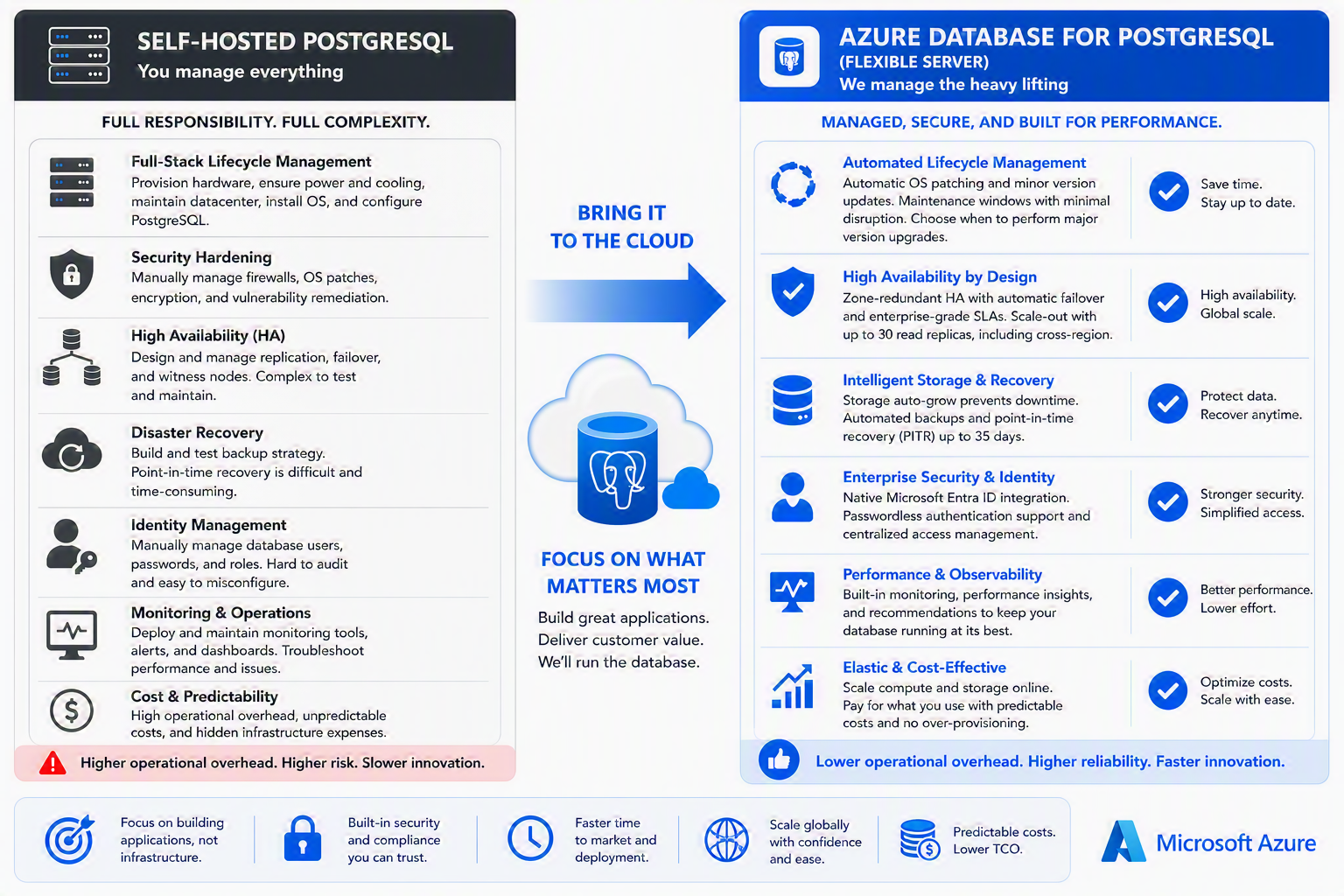
Summary This post is for technical decision makers evaluating where to run production PostgreSQL workloads. It compares two valid operating models—self-managed PostgreSQL and a managed database service—through business and operational outcomes: control, engineering capacity, resi

Official announcement
OpenClaw went viral. Meet the maintainers building and securing it.
Gregg Cochran
What began as a personal experiment quickly became a global open source project with extraordinary momentum. OpenClaw is a personal AI assistant that runs on users’ devices and connects with the messaging channels they already use. Started by Peter Steinberger as a weekend projec

Official announcement
IBM Brings AI-Powered US Open Fan Experience Back to Madison Square Park
IBM Newsroom
Join IBM for AI-powered tennis activations, live US Open match viewing, giveaways and more during Championship Weekend