
Official announcementNVIDIA Newsroom
NVIDIA Alpamayo 2 Super, the Frontier Open Model for Robotaxis and Autonomous Vehicles, Now Available for Commercial Use
For robotaxis and other autonomous vehicles (AVs), the hardest problems aren’t the everyday scenarios. They’re the rare, complex situations that are difficult to anticipate and train for. Handling these long‑tail events takes more than just object detection and motion prediction.

Open commercial licensing, benchmark‑leading reasoning and inspectable decisions bring autonomous vehicles, including robotaxis, closer to production and widescale deployment.
August 4, 2026 by Jessica Soares
0 Comments
-
X
-
-
- [
Copy link
Link copied!
](#)
For robotaxis and other autonomous vehicles (AVs), the hardest problems aren’t the everyday scenarios. They’re the rare, complex situations that are difficult to anticipate and train for.
Handling these long‑tail events takes more than just object detection and motion prediction. AVs must understand the situation, reason about cause and effect, choose the right action and turn that decision into a safe, comfortable path — all in real time and in a way developers can inspect, validate and trust.
NVIDIA Alpamayo 2 Super, available now for commercial use, is part of the Alpamayo family, the most-adopted open reasoning models for autonomous driving on Hugging Face, supporting a wide range of AV-relevant capabilities within a single foundation model.
Built on NVIDIA Cosmos 3 Super Reasoner and post‑trained with reinforcement learning, the model advances the AV ecosystem on two fronts: open commercial licensing and leading multitask capabilities for autonomous driving.
Alpamayo 2 Super is part of NVIDIA’s growing collection of open models, datasets and tools for autonomous driving, expanding access, strengthening competition, giving developers greater control and supporting safer, more transparent AV deployment.
Open Licensing for Production AVs
Alpamayo 2 Super is available on Hugging Face under OpenMDW‑1.1, the Linux Foundation’s permissive license for open AI model distributions. The license covers fine‑tuning, derivative models and commercial redistribution, allowing AV developers, automakers, truckmakers and suppliers to adapt Alpamayo to their own data, driving policies and deployment strategies.
This openness lets AV researchers and companies keep control of their own data and infrastructure, as well as own the value they create through specialized models and accumulated know‑how. Such control is essential for workflows involving proprietary fleets and safety.
Earlier Alpamayo releases were initially introduced for R&D. The OpenMDW license is now being applied across the entire Alpamayo model family so developers can deploy any of the models commercially without requiring additional permissions. This creates a direct path from adaptation to deployment.
Open weights make that path economically viable. Teams can build on advanced reasoning without re‑training every foundation capability from scratch or paying frontier‑model costs for every task, matching the right model to the right job at the right cost.
Alpamayo 2 Super enables frontier-scale reasoning in cloud-based development workflows, where developers can generate high-quality reasoning traces, synthetic training data and teacher outputs for model distillation. Within the Alpamayo model family, Alpamayo 2 Super delivers the highest reasoning and driving performance for multimodal autonomous driving development, while Alpamayo 1.5 and Alpamayo 1 provide more cost-efficient options for cloud-based development and model distillation.
The resulting distilled models can then be optimized for efficient, real-time inference in production vehicles. Together, the Alpamayo model family provides a cloud-to-car workflow that combines frontier-scale reasoning with scalable deployment across commercial AV fleets.
For AV programs, that means frontier‑scale reasoning in the cloud and efficient, specialized models in the vehicle — a more sustainable way to scale safe autonomy into commercial fleets.
Benchmark-Leading Reasoning at Frontier Scale
Alpamayo 2 Super ranks first on LingoQA, an autonomous driving reasoning benchmark, among nearly 40 models evaluated. In NVIDIA testing using the Lingo‑Judge metric, it outperformed Qwen2.5‑VL 72B by 17.0 points, Gemini 2.5 Pro by 15.1 points and GPT‑4o by 23.2 points, demonstrating state‑of‑the‑art reasoning for driving‑centric scenarios. Alpamayo 2 Super also ranks first across all autonomous driving benchmarks evaluated by NVIDIA, underscoring its leading performance across a broad range of AV capabilities.
Alpamayo 2 Super offers 3x the scale of the 10‑billion‑parameter NVIDIA Alpamayo 1.5 and Alpamayo 1 models. The added capacity helps the model better generalize reasoning from sparse examples — a critical capability for the rare, multi‑agent interactions where conventional systems often struggle.
The model reasons over full‑surround camera coverage, fusing views from the vehicle’s front, sides and rear. This 360‑degree context enables richer understanding of lane changes, merges, unprotected turns and complex intersections, where risks commonly arise.
A Multitask Foundation Model for Robotaxis and Autonomous Driving
For each driving situation, Alpamayo 2 Super can produce five tightly coupled outputs:
- A trajectory describing the vehicle’s planned path.
- A chain‑of‑causation (CoC) trace that explains the reasoning behind the decision.
- A meta‑action (e.g., yield, lane changes, stops) that captures the model’s intent.
- Reasoning auto-labels that generate CoC annotations for training and validation data.
- Visual question answering responses with 2D visual grounding that link the model’s answers to specific regions in camera images.
Together, these outputs offer insight into the model’s decision-making process. Developers can tie what the model observed to the action it selected, making decisions easier to understand, critique and validate.
CoC traces integrate with NVIDIA Halos safety‑validation workflows and support AI safety aligned with ISO/PAS 8800 requirements, providing a stronger foundation for AV safety engineering.
Alpamayo 2 Super can also be deployed as an autolabeler to generate CoC labels and perform visual question answering with 2D grounding on proprietary fleet data. By linking its reasoning to specific regions in camera images, the model can transform raw driving clips into richer training data, compressing annotation cycles from months to days.
Beyond planning and auto-labeling, Alpamayo 2 Super supports scene understanding, model critiquing and knowledge distillation. These multitask capabilities enable developers to use a single foundation model across more of the development stack, simplifying tooling and accelerating iteration.
An Open Ecosystem for Reasoning‑Based AVs
Alpamayo 2 Super is part of a broader family of open models, frameworks and datasets for AV development.
Other tools in the family include:
- NVIDIA AlpaSim, which provides closed‑loop simulation.
- NVIDIA AlpaGym, which enables high‑throughput reinforcement learning.
- NVIDIA Physical AI Open Datasets, which supply data for training and testing.
- Open training recipes and an autolabeling pipeline to accelerate model development, training and validation.
Alpamayo has already surpassed 500,000 downloads on Hugging Face, reinforcing its position as the most-adopted open reasoning model family for autonomous driving on the platform.
Download NVIDIA Alpamayo 2 Super on Hugging Face to explore the model, evaluate its reasoning capabilities and start building the next generation of robotaxis and autonomous vehicles.
- Categories:
- Driving
- Tags:
- Artificial Intelligence
- Computer Vision
- Mobility
- NVIDIA Halos
- Open Source
- Physical AI
- Synthetic Data Generation
Related News
Gaming
GeForce NOW Gives Gamers More Ways to Play at Gamescom 2026
Aug 27, 2026
Gaming
Bring the Fire: Play Games on GeForce NOW With New Firefox Browser Support
Aug 20, 2026
Gaming
Class Is in Session: GeForce NOW Levels Up Linux, Chromebooks and More
Aug 13, 2026
Gaming
GeForce NOW Shakes Up August With 26 New Games
Aug 6, 2026
Related stories

Official announcement
Samsung Galaxy S26 FE: Delivering the Latest Flagship Experience, Focused on What Matters Most
Samsung Newsroom
Samsung Electronics today announced Galaxy S26 FE, the newest addition to the Galaxy S26 family and the first in the lineup to launch with One UI 9 — bringing the latest premium Galaxy experiences to more users from day one. With enhanced camera capabilities and more context-awar

Official announcement
Giga-Scale AI and the Ethernet Evolution: How Spectrum-X Ethernet Rewrites the Rules
NVIDIA Developer Blog
The massive growth of generative AI has fundamentally altered data center design. As distributed model training scales to span hundreds of thousands of GPUs,... The massive growth of generative AI has fundamentally altered data center design. As distributed model training scales

Official announcement
How AI Coding Agents Can Unlock Materials Simulation with NVIDIA ALCHEMI Toolkit
NVIDIA Developer Blog
Atomistic simulation requires three things: knowledge of the science, compute-efficient implementation of simulations, and accessible interfaces to the... Atomistic simulation requires three things: knowledge of the science, compute-efficient implementation of simulations, and ac

Official announcement
Samsung Introduces New Odyssey Lineup for Fast-Paced Gaming at Gamescom 2026
Samsung Newsroom
Samsung Electronics today announced its 2027 Odyssey gaming monitor lineup at Gamescom 2026, the world’s largest gaming event, being held in Cologne, Germany from Aug. 26-30. The new lineup introduces multiple Odyssey models that feature world-first innovations, empowering player
Official announcement
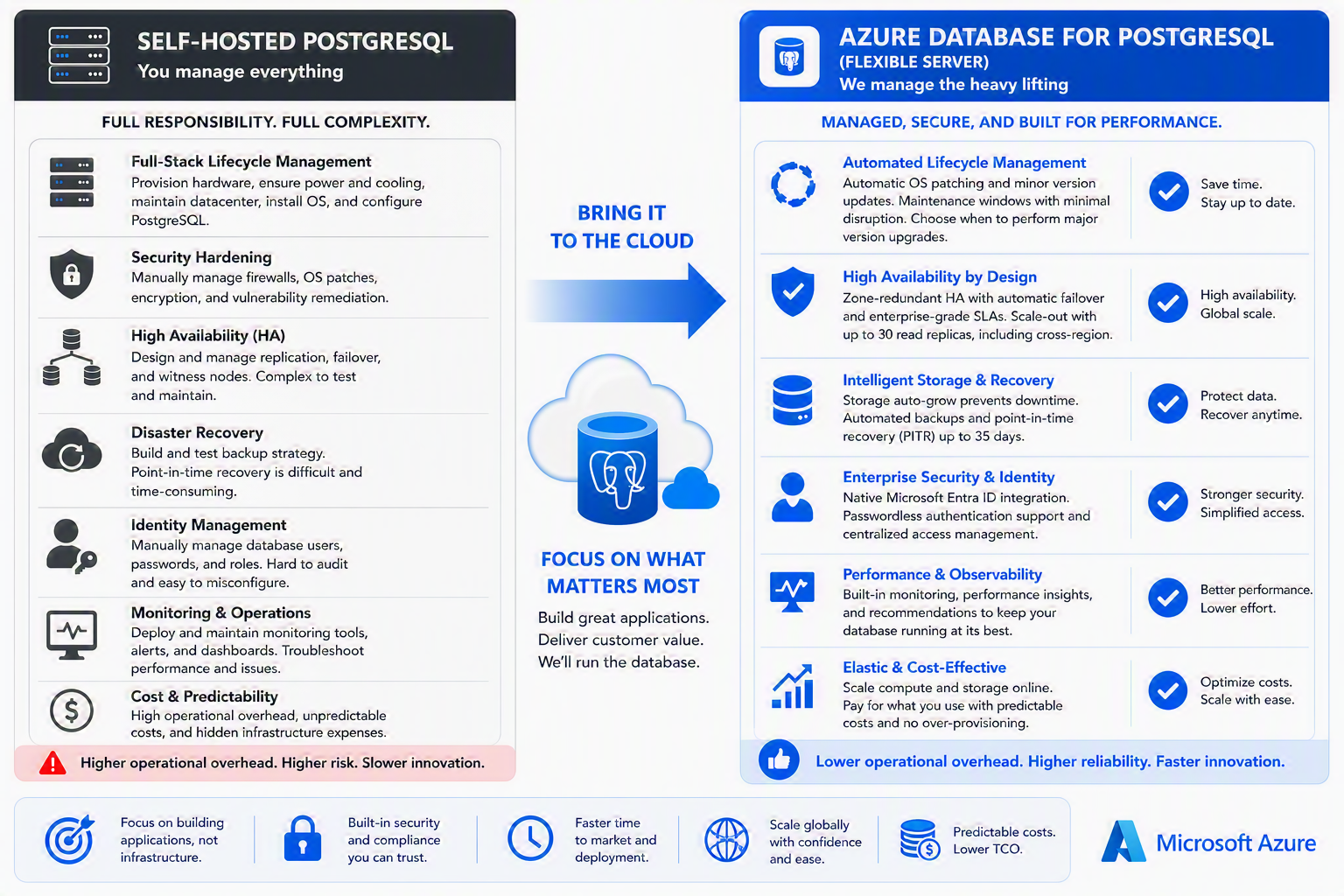
Managed PostgreSQL vs. self-hosted PostgreSQL: Key benefits and trade-offs
Lauro Ojeda
Summary This post is for technical decision makers evaluating where to run production PostgreSQL workloads. It compares two valid operating models—self-managed PostgreSQL and a managed database service—through business and operational outcomes: control, engineering capacity, resi

Official announcement
OpenClaw went viral. Meet the maintainers building and securing it.
Gregg Cochran
What began as a personal experiment quickly became a global open source project with extraordinary momentum. OpenClaw is a personal AI assistant that runs on users’ devices and connects with the messaging channels they already use. Started by Peter Steinberger as a weekend projec